Congress, BJP can’t connect with young Indian voters
Regional parties capitalising on leadership vacuum in mainstream political outfits
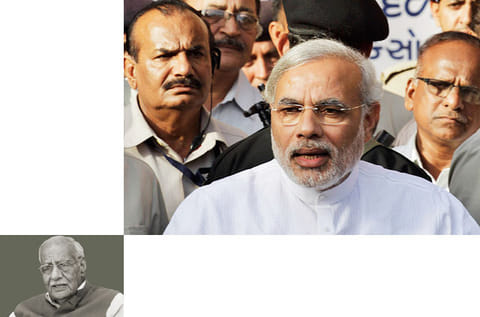
The Bhartiya Janata Party (BJP) seems to have a tryst with doom. In the wake of scams and scandals in the Congress-led United Progressive Alliance (UPA) government, the BJP was gaining ground. Its performance in parliament was comparatively better and its younger leadership assertive. But once again old Rashtriya Swayamsevak Sangh (RSS) men have brought the party back to square one.
First, Gujarat Chief Minister Narender Modi crossed swords with Bihar Chief Minister Nitish Kumar on the concept of secularism. Then the RSS played the Hindutva card. Both have scotched even the remotest chance of the BJP returning to power. Modi, a person who has his hands tainted with the blood of Muslims, cannot be projected as India’s next prime minister.
The BJP has, by and large, remained quiet. One of its leaders spoke out of turn and questioned the very concept of secularism, but he was hushed up quickly. It seems that the party did delude itself with the idea that the Hindu voters were beginning to own the RSS philosophy. The BJP should have learnt the lesson in 2009 when it was all set to win, but lost to the Congress.
Political parties, including the Congress, do not understand the mostly young new electorate. It is liberal in outlook and hates to mix religion with politics. This was the ethos that the nation adopted during the independence struggle and after freedom under the leadership of Mahatma Gandhi, Jawaharlal Nehru and Maulana Abdul Kalam Azad.
True, regional chauvinism is rearing its ugly head. This is because the Centre looks confused when it comes to policies which demand secular credentials. Receiving little feedback from the field, New Delhi continues to monopolise power and fails to appreciate that decentralisation would infuse life among the people in a state. Regional aspirations have gained a new edge and the locals are fired with confidence that they can sort out their problems themselves and find a consensus quicker than a remote New Delhi can.
This is the reason why parties like the Trinamool Congress and Samajwadi Party won in West Bengal and Uttar Pradesh respectively. The voters found the parties closer to them and more sympathetic to their problems. Even if these regional parties do not give them a better administration the people are not likely to go back to all-India parties which they have found failing them again and again. They may try another party within the region because they are getting convinced that all-India parties are not an answer to their problems of appalling living conditions.
The idea of India may be pushed further into the background. There may be insurgents and separatists in certain areas to assert the identity of their caste or community, believing that, in the affairs of all-India politics, they may get lost. Much would depend on how New Delhi handles the situation. The Sarkaria Commission on Centre-State relations has become outdated. Had its recommendations been implemented when the report came out more than two decades ago, the demand by the states to have more powers might not have arisen. The Centre has to curtail the subjects it has, either voluntarily or through a Constitutional amendment. Apart from defence, foreign affairs and overall financial planning, New Delhi should not have more subjects. Once it decentralises its power it should ensure that the decentralisation goes all the way, from the state capital to the district and then to the Panchayat so that people themselves participate in governance.
The Congress, the BJP and the Left would have problems. The Left does not seem to bother because it is dictatorial in its working. The CPM ousted a member from the party even though he had resigned after supporting Pranab Mukherjee, the Congress Party’s presidential candidate. Yet both the Congress and the BJP need to handle their members carefully. Even when a state chief minister speaks out of turn, he has to be brought around as has been the case with Chief Minister Prithviraj Chavan, although he is a creature of Congress president Sonia Gandhi.
The BJP faces a bigger problem because it rules in twice the number of states as the Congress does. Leave Modi apart — he is a bull in the China shop — the chief ministers in Madhya Pradesh, Chhattisgarh and Karnataka are too tall to tame. They are leaders of their own communities and command wide influence.
Both parties would have great difficulty for the 2014 election, first in choosing the top person and then tackling him or her. Take for example the BJP, it is already wooing Vasundheraraje Scindia, former chief minister, who thumbed the party and stayed in the wilderness because she was sure that the central BJP would one day come to her and accept her authoritarian leadership.
Problems of the Congress on this count are negligible. Sonia has all the authority. That Rahul Gandhi, her son, should be nominated as number two has already been done. There is no dissidence and she alone, more so after the departure of Pranab Mukherjee, has the confidence of allies in the UPA she chairs.
The BJP would need more and more assistance of RSS to sort out difficulties with the state leaders. Realising this, RSS chief Mohan Bhagwat has announced that Modi has all the qualifications to become India’s new prime minister. However, this has naturally infuriated the BJP’s main ally, Janata Dal (United). Its President Sharad Yadav has said that if Modi is the prime minister candidate, the JD (UP) would quit the BJP-led National Democratic Alliance (NDA).
What is wrong with having a Hindutva prime minister, questions Bhagwat. This question itself shows how RSS lives in a world of it own and does not face the reality of secular India. For the BJP, already a divided house, the confusion is more confounded. It realises that the country can never be ruled through a communal agenda. Even former prime minister Atal Behari Vajpayee realised this and always put his liberal foot forward. He refused to oust his principal secretary Brijesh Mishra despite the pressure of RSS. But then the BJP’s problem is that it does not have a tall person like Vajpayee to withstand the pressure of RSS.
— Kuldip Nayar is a former Indian high commissioner to the United Kingdom and a former Rajya Sabha member.


